 .
.Liu & Zenner method
The basic formula is very complicated:
.
Four different fatigue limits f-1, f0, t-1 and t0 are needed for setup of all necessary material constants:
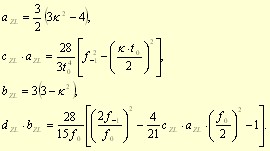
The dependency of the criterion on four material parameters was criticized by Papadopoulos in [PDG97] and led him to exclusion of the criteria from his comparison. Zenner et al. opposed his objections in [ZSL00] with a reference to common methods used for the derivation of fatigue limits in repeated loading from their fully reversed counterparts.
NOTIFICATION: Determination of the value of fatigue limit in repeated axial loading can be done in different ways – [ZSL00] e.g. uses another known value (mean stress sensitivity). There are many other different approaches how to get the fatigue limit in repeated axial loading, while no general formula can be used – see [Ppg05] for information.
Knowledge of fatigue limit in repeated torsion is even more rare. I do not know any more comprehensive analysis of its determination. Thus, if the value is not set in PragTic (input zero as the TORS0 parameter), the following formula given in [ZSL00] is used automatically:

The authors [ZSL00] claim the criterion to be valid within the bounds:

The only really significant source of validity of this criterion is the FatLim Database, data provided by Zenner et al. in [ZSL00] are unclear.
Nomenclature:
|
Mark |
Unit |
PragTic variable |
Meaning |
|
|
[MPa] |
shear stress amplitude on an examined plane |
|
|
|
[MPa] |
mean shear stress on an examined plane |
|
|
|
[MPa] |
TENS-1, BEND-1 |
fatigue limit in fully reversed axial loading |
|
|
[MPa] |
TENS0, BEND0 |
fatigue limit in fully repeated axial loading |
|
|
[-] |
ratio of fatigue limits ( |
|
|
|
[MPa] |
amplitude of normal stress on the plane examined |
|
|
|
[MPa] |
mean (average value of maximum and minimum values) normal stress on the plane examined |
|
|
|
[MPa] |
TORS-1 |
fatigue limit in fully reversed torsion |
|
|
[MPa] |
TORS0 |
fatigue limit in repeated torsion |
Methods & Options & Variables of Calculation – Edit
Decomposition
Elasto-plasticity
- No – currently no option implemented
Solution option
- Searched planes <0~BS algorithm, 1~globe analogy, 2~random>
- Number of scanned planes
- Only every x-th data-point taken from load history
- Evaluate envelope curve only <1~yes, 0~no>
Solution variable
- Minimum damage – this option is not active for this high-cycle fatigue method
Material parameters
|
E |
[MPa] |
tensile modulus |
|
NU |
[-] |
Poisson’s ratio |
|
TENS0 |
[MPa] |
fatigue limit in repeated tension (or plane bending) |
|
TENS-1 |
[MPa] |
fatigue limit in fully reversed push-pull (or plane bending) |
|
TORS-1 |
[MPa] |
fatigue limit in fully reversed torsion |
|
TORS |
[MPa] |
fatigue limit in fully repeated torsion (see the text above, if not available) |
Result detail variables
Damage fatigue index is computed, not the damage as a reciprocal value to number of cycles or repetitions
FDD1 MAXDP maximum of damage parameter
FDD2 NCX x-coordinate of the normal line vector of the plane with MAXDP
FDD3 NCY y-coordinate of the normal line vector of the plane with MAXDP
FDD4 NCZ z-coordinate of the normal line vector of the plane with MAXDP
FDD5 ALFA angle between the normal lines to the critical plane and to the free surface
© PragTic, 2007
This help file has been generated by the freeware version of HelpNDoc


 )
)


